
Why Enterprise Technology Failures Are Rarely Technical Problems
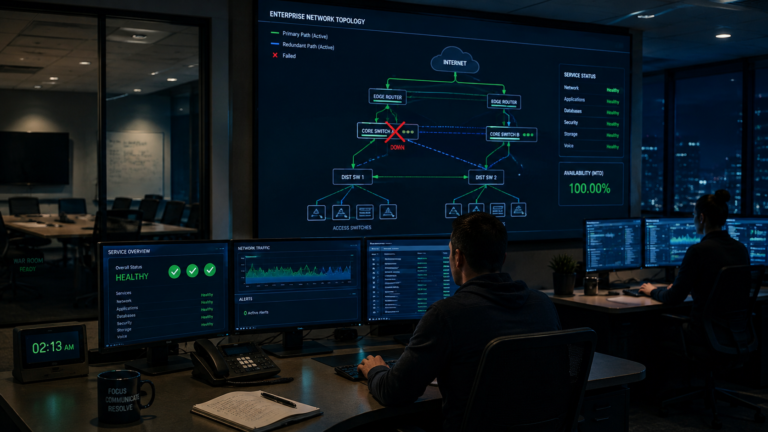
I spent years as a Global Operations Manager for Major Incident at a large enterprise managed services organization. My job was to own the moment when something broke—coordinating technical teams, managing customer communications, and keeping executive stakeholders informed in real time across a customer base of 50+ companies, some with user environments serving 150,000 people.
After years handling hundreds of enterprise incidents, I learned something that still surprises people when I say it: the technology usually wasn’t the thing that failed first.
The communication did.
Not once. Not occasionally. Consistently, across hundreds of incidents spanning years of enterprise operations, the pattern was the same. By the time I was on the phone with a C-suite stakeholder at 2am, the technical problem was usually well understood and actively being worked. What was broken—what was actually causing damage—was everything around it.
Here’s what that actually looks like in practice.
Problem One: People Can’t Ask for What They Actually Need
It starts before any system goes live. Requirements gathering is where communication failure plants its seeds, and those seeds grow into incidents months or years later.
On one end, organizations over-specify. A reasonable core requirement becomes surrounded by feature creep—additions that sound valuable in planning meetings but have little relationship to the actual business problem. The result is unnecessary complexity and systems that eventually fail in ways nobody anticipated.
On the other end, organizations under-specify. Stakeholders quietly negotiate against themselves, never asking for what they actually need because they assume the request will be rejected. Eighteen months later, the missing capability becomes critical.
Both failure modes originate in the same place: an inability to clearly articulate what is actually needed and why.
Problem Two: Customers Propose Solutions Instead of Describing Problems
This one drives engineers quietly insane, and I understand why.
When something breaks, there is a precise and important discipline to communicating what happened. You are either the customer or the engineer. Not both.
If you bring in an expert to diagnose and resolve a problem, your job is to describe the symptoms with as much precision and detail as you can provide. What changed? What are you observing? What’s the impact? That’s the brief. From there, the engineer’s job is to propose the fix.
What actually happens, far too often, is that the customer arrives with a solution already in hand. They’ve decided what’s wrong and what needs to be done about it. They present this to the engineer not as a hypothesis but as a directive.
This creates two problems simultaneously. First, the proposed fix is frequently wrong—not because the customer is unintelligent, but because they lack the technical context to correctly diagnose the root cause. Second, and more insidiously, it narrows the solution space. An engineer handed a solution is now working to validate or implement that solution rather than finding the actual one.
You hired the expert for their expertise. Let them use it. Describe the problem. Let them propose the fix.
Problem Three: Leadership Operates on Incorrect Operational Models
This is the most common failure mode at the executive level, and it’s the hardest to address because it involves asking people to acknowledge the limits of their own understanding.
Enterprise technology systems are complex. They are designed with specific parameters, staffed to specific ratios, and dependent on processes and procedures that exist for reasons that aren’t always visible to the people above them. When something goes wrong, leadership frequently arrives at the incident with an incorrect operational model—an understanding of how the system should work that has little relationship to how it actually works.
This isn’t negligence. It’s the natural result of organizational distance from technical operations. But it creates a specific and damaging communication problem: leadership issues direction based on an incorrect model, that direction conflicts with what the technical team knows needs to happen, and the technical team is now navigating both the incident and the organizational friction simultaneously.
The resolution timeline extends. Decisions get made that need to be unmade. Energy that should be going toward restoration goes toward managing upward.
The fix is not to demand that executives understand every technical detail—that’s neither realistic nor their job. The fix is to establish, before incidents happen, a clear and trusted chain of technical authority. When the system is on fire, someone needs to be empowered to say: this is what we’re doing, this is why, and here is when I will update you next. That person needs to be believed.
The Pattern
Requirements miscommunication. Solution-first problem reporting. Leadership operating on incorrect operational models. Three distinct failure modes, and none of them are technical.
The technology is usually the last thing to give way. It gives way because the communication around it already has.
I’ve watched this pattern repeat across hundreds of incidents, dozens of organizations, and multiple industries.
The organizations that handle major incidents best are rarely the ones with the newest technology.
They are the ones that build the communication infrastructure around that technology: clear escalation paths, trusted technical authority, disciplined incident processes, and organizational trust in the people closest to the problem.
Technology failures are rarely technical failures.
More often than not, systems break exactly where human communication already has.
Discover more from At Ground Level
Subscribe to get the latest posts sent to your email.