Who the Ban Can Bind
Section 15 of the Ban Artificial Superintelligence Act of 2026 is two sentences long. The first directs the Secretary of Artificial Intelligence, working with the Secretary of State, to pursue international agreements and allied coordination. The second declares that “it shall be the policy of the United States to prevent the development of artificial superintelligence globally, which may include export controls on artificial intelligence computing infrastructure.”
Globally. The goal is worldwide. The agreements that would deliver it do not exist yet, and the bill’s other obligations do not wait for them.
The statute needs a defendant
Read sections 8, 9, 12, and 13 as an enforcement problem rather than a policy statement and the shape becomes clear. The pause applies to systems somebody is developing. The charter requirement applies to a person who wants to develop or distribute. The penalties attach to policymaking individuals, to non-policymaking employees, and to “rogue actors,” all of them people with addresses. Forfeiture requires assets a court can reach.
American criminal law is not strictly territorial, and some statutes reach conduct abroad. But reach on paper and reach in practice are different things. Jurisdiction, custody, seizure, and the cooperation of a foreign government are four separate problems, and a lab operating beyond effective US enforcement presents all four at once.
So the obligations land hardest and soonest on the people this government can actually summon.
The lever with a record, loosened while the bill was being written
Give section 15 its due: compute is the most observable link in this chain. Weights are a file, and files move silently. Fabrication plants, data centers, and megawatt-scale power draw leave signatures. If one instrument has a plausible chance of reaching past the border, export controls on computing infrastructure are it, which is presumably why the bill names them.
Then look at what that instrument is doing. On January 13, 2026, Commerce published rules permitting sales of advanced AI chips to China below a defined performance ceiling, capped at half the volume sold to US customers. The Council on Foreign Relations calls that policy strategically incoherent and unenforceable, arguing it either blocks nearly everything or accomplishes nothing, and that outright denial is the only coherent version. Note the direction of that criticism: not that export controls cannot work, but that this version undermines their purpose.
Either way, the bill leans on an instrument another part of the same government is currently loosening.
The asymmetry is in who can be prosecuted
Section 9(b) prohibits deploying, releasing, transferring, or importing any system “that may be foreseeably modified” to produce superintelligence or precursor characteristics. Section 9(a) goes further, reaching anyone who would “acquire, possess, fund, import, or transfer” a covered system.
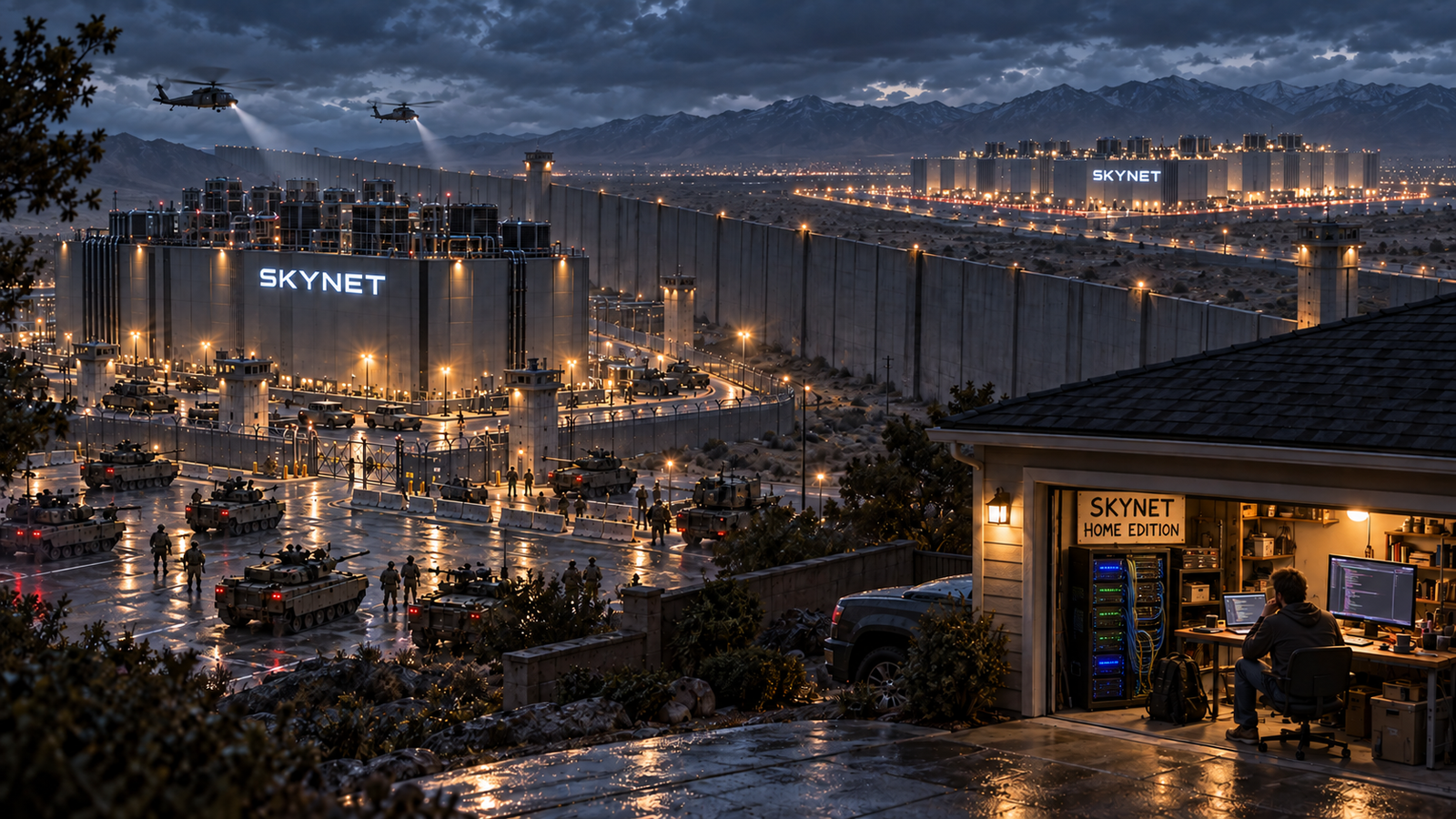
Notice what that means for the developer in his spare room. Foreign origin buys him nothing. Downloading a capable open-weight model from a lab in another country is acquisition and importation, and if that model displays a precursor characteristic, he is inside the prohibition the moment it lands on his drive.
The asymmetry isn’t in what’s available. It’s in who can be reached. The weights stay obtainable, hosted in jurisdictions the Department cannot inspect and published by organizations beyond effective US enforcement. The person who downloads them lives in Ohio.
That foreign ecosystem is not hypothetical. In the first seven months of 2026, Chinese labs shipped the largest open-weight models by parameter count in most months, and Qwen became the community’s default foundation with roughly two billion downloads this year and more than 151,000 community-built variants. American labs shipped substantial open models too, Nemotron 3 Ultra among them at 561 billion parameters. The point isn’t a scoreboard. It’s that a large, actively used, non-American supply of capable weights already exists, and this bill cannot by itself ensure the people producing it comply with anything.
What happened the last time
We have run a version of this experiment, on software the government sincerely believed was dangerous.
Until 1996, strong encryption sat on the United States Munitions List, regulated as a weapon. Export required a license, key lengths were capped, and American companies either shipped deliberately weakened products abroad or skipped foreign markets, while strong foreign encryption remained freely available. An executive order moved most commercial encryption to the Commerce Control List in 1996, the administration announced a broad liberalization in September 1999, and the implementing rule arrived in January 2000.
What followed wasn’t abolition. That rule kept technical review, kept reporting requirements, kept licensing for foreign government end users, and kept the embargoed destinations. What changed is that the restrictions stopped being aimed at the general commercial market, because foreign availability had already drained them of effect while American suppliers went on paying their cost.
That mechanism is the precedent, not a prediction. Controls on a portable technology lose force as equivalent capability appears elsewhere, and the parties still carrying the burden are the ones inside the jurisdiction.
The argument that deserves an answer
The strongest case against everything above is straightforward. Most frontier-scale training still happens on American soil, with American capital, at American companies. If you host the frontier, binding yourself binds a great deal, and delay is not nothing. Slowing the most capable actors could reduce risk even without universal compliance.
That case is serious, and it’s the one the bill’s supporters should be making. It also leaves a question the findings never take up: how much delay does a unilateral pause actually buy, and how does that compare with what it costs domestically before any reciprocal restraint exists?
The first complication is tracing. Section 9(c) shows why. The Department is to monitor advanced systems and systems distilled from them, across pre-training, mid-training, post-training, and post-deployment. That is an enormous surface, evaluated against characteristics the bill never makes testable. Claiming the whole chain and being able to trace it are different things. The expected benefit depends on how much of that chain the Department can actually trace.
The second complication is that the frontier’s location is a fact about today, not a fixed property. Training work is already being spread across the public internet. Methods that let nodes work independently between synchronizations have cut the bandwidth cost by two orders of magnitude, and Prime Intellect coordinated more than 800 contributed nodes to post-train a 32-billion-parameter model with asynchronous reinforcement learning. Efforts like that sit roughly a thousandfold below frontier scale, and Epoch AI researcher Jaime Sevilla, writing in December 2025, judged them unlikely to match the frontier this decade. He also put their growth at about 20 times a year since 2020, against roughly five times a year for conventional training. A pause measured in years is a long time for a trend line like that. And dispersion cuts both ways as an enforcement matter: more jurisdictions means more infrastructure to trace and more governments whose cooperation is needed, while the organizer may remain perfectly identifiable. Establishing what a distributed operation consumed in total compute, and getting access to the machines that supplied it, are separate problems from knowing who ran it.
Who can afford the paperwork
Section 12 sets the terms of admission. To develop or distribute an advanced model, you need a federal charter, and to get one you agree to give the Secretary “full access to such advanced artificial intelligence systems, processes, staff, and physical infrastructure” as the Secretary considers appropriate. On an upheld finding of violation, intellectual property and assets are forfeit.
Nothing there bars an individual. Charters issue to a “person,” and most people using hosted tools aren’t developing or distributing an advanced model at all. The barrier is what surrounds eligibility: counsel to read the definitions, documentation to survive an audit, delay at pre-deployment approval, exposure to inspection, and dependence on models that may not clear review. Large organizations already carry that overhead. It has a name, a budget, and a department.
The burden would also arrive two different ways. Some small developers would face obligations directly. Others would feel it through their suppliers, in tools withdrawn, delayed, or repriced.
Which matters because of what these tools have made possible for people without teams. Working alone with a Mac and a subscription, I ship work that would once have taken a small team a quarter. Someone whose formal training ended years ago can stay current without tuition or time off, and the cost of keeping myself current has fallen further in the last three years than at any point in my working life. The people who stay employable are the ones who keep learning, and that just got cheaper for anyone willing to do it.
That participant has the least capacity to absorb a compliance regime and the most to lose if the tools thin out. Care won’t be the deciding factor. Carrying the compliance cost will be.
What happens in the interval
Section 15 promises a worldwide result and assigns someone to go negotiate it. Section 8 starts the pause on the day the bill is signed.
Nothing conditions the second on the first.
Everything in that interval falls on the people this government can reach, and which of them keeps working is decided by who can carry the compliance.
Whatever that buys in safety, it also decides who is left building. That part isn’t in the findings.
The Superintelligence Ban, part two of two. Part one, “What the Ban Can Measure”, examined the bill’s definitions and who holds the discretion to apply them.
Discover more from At Ground Level
Subscribe to get the latest posts sent to your email.