No Board for November
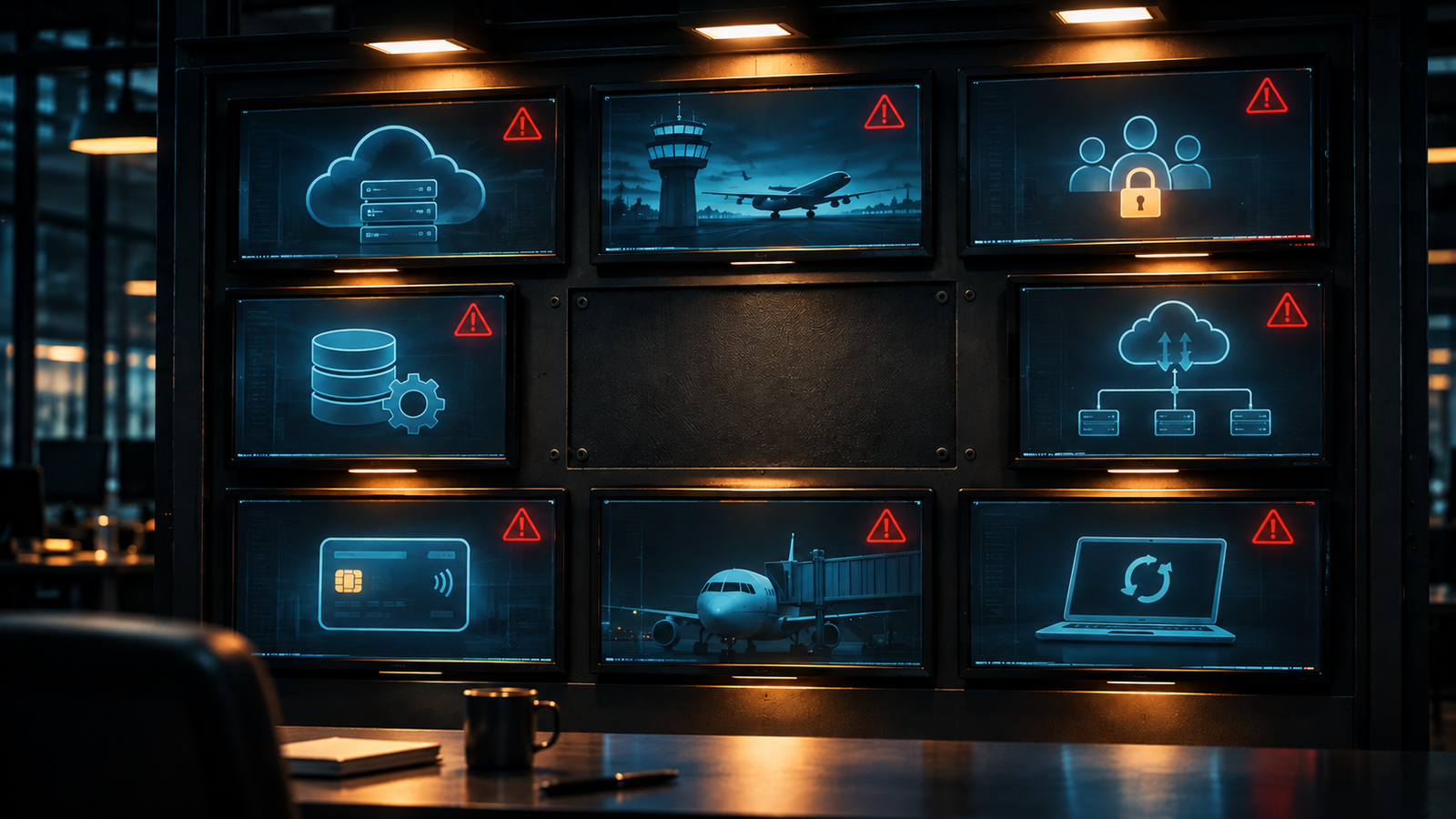
Six days. Eight outages. Microsoft 365 went dark for most of a day. The FAA grounded every departure in the country. Workday locked employees out of payroll. A slice of AWS stopped signing people in. Chase stalled payments. United held its planes at the gate. Apple’s services faltered. Then the NSA lost its classified internal network.
Each came with a cause, or with none at all. A latent defect. A new router. A maintenance check. A software bug. An internal update. Routine maintenance.
AI? A foreign power? Some other bad actor?
Or something else entirely?
I didn’t believe it either
I read those causes and did not believe them.
That was not a considered position. It was a reflex, and I have had it for thirty years. A cluster of major failures inside a single week does not look like coincidence to someone who spent a career running major incidents. It looks like one thing wearing several names.
So before I say anything about what anyone else concluded that week, I should be plain about where I started. I started where the conspiracy theories start.
Six outages, one board
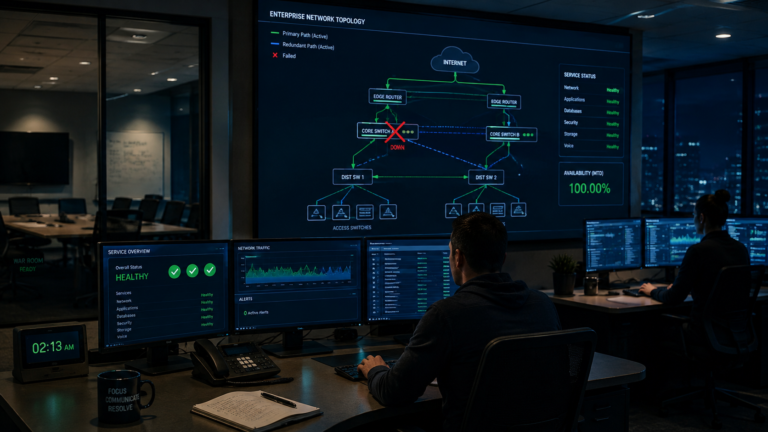
There were nights when everything seemed to break, one service after another. Before it was over I would have half a dozen outages or more running from a single board. Each had its own team. All of them took their lead from one team: the one working the core outage.
There was always a core outage. And every time, it was the network. Sometimes it was routing. Sometimes it was a single firewall, a concentrator, or a router. Sometimes it was a fiber cut. Once it was a data center. The shape never changed: one point failed, and everything downstream of it failed with it.
I have written about the night the network was blamed and turned out to be clean. That was one transaction stalling while three teams reported healthy components. This is the other kind of night, when many things fail together. On those nights the network earned its reputation.
That is where the reflex comes from. Six failures on one board were never six failures. They were one, and the job was to find it.
The suspect arrives before the evidence
Finding it took time, and the room did not wait.
Some people were simply disoriented. Others had a theory within minutes. At one organization, a few were sure it was hackers. That organization was not well liked in the press at the time, and an attack was the story that fit what everyone already believed about it. Nothing on the board pointed to an intrusion. The reputation did.
The worst night was the one where the suspect was standing in plain sight. The network team had a major change scheduled, and they were executing it at the moment things went down. Nobody needed convincing. The change was in progress, the failures began, and the room had its answer.
It was the wrong answer. The cause was a different change entirely, made on a server.
The timing was real. It was also a coincidence. Two changes were in motion that night, and the room convicted the one it could see.
Neither suspect was chosen by evidence. One was chosen by reputation and the other by timing. Evidence came later, from someone tracing what the failures actually shared.
Eight rooms, no core
So I did with November what I would have done on the board. I went looking for the core outage.
Microsoft’s final report names four factors: a latent defect on its gateway servers, about 14 percent of gateway capacity offline for routine deployment work, a failover that moved Teams traffic onto the same gateway, and the daily peak in load. The defect had been in place since July without incident. It took the other three to expose it. The FAA’s initial investigation points to new routers at two sites that overloaded its telecommunications network during a contractor’s cutover from copper to fiber; the root cause is still open. Workday told customers that services in its disaster recovery site had connected to production databases during a weekly maintenance check. Chase described a software bug in an on-premise hardware system. Apple pointed to an internal update. The NSA said its network degraded during scheduled routine maintenance.
AWS has published no cause. Neither has United.
That is the record as of this writing, and much of it is preliminary. It contains no shared cause. The only links anyone has demonstrated are downstream ones: a failure at one company breaking something that depended on it.
What failures can share
Five of the six stated causes do share a shape. A deployment. A cutover. A maintenance check. An update. Scheduled maintenance. Each begins with planned work on something a great deal else depended on. The sixth is a bug, and Chase has said no more than that. CNN, citing a person familiar with the matter, reports that the bug arrived with an update to the bank’s own systems.
None of these organizations has said why its work was happening that week, and I don’t know. What follows is my experience, not their record.
This is the season for it. In my past roles, the weeks before the holidays were when year-end changes went in, and the holiday stretch itself was the preferred window for high-risk work, because offices and schools empty out and demand drops. I have written before about what a calendar rule does and does not examine. If the same thinking was at work in November, then some of what looked like eight failures arriving together was eight organizations independently choosing the same weeks. A shared philosophy about scheduling major change is something failures can have in common. It is not an author.
One connection is on the record, and it has nothing to do with the season. On October 21 the FBI, the NSA, and CISA told organizations to patch a pair of critical flaws in PHP immediately. Those flaws had been found with the help of AI tools. The Director of National Intelligence has since said that patching after the PHP update left some NSA systems failing to come back up. Fortune reports that a Senate office has linked the banking outages to the same scramble; Chase has said only that its failure was a bug in its own systems. The FAA’s failure was hardware. Microsoft’s defect dates from July.
There was no board for November. There were eight rooms. A shared pressure may run through a few of them. Nothing on the record runs through all eight.
An apology that has to say what it wasn’t
The world has let the devil off the hook now that it has AI to blame.
The devil was always a useful suspect. He explained misfortune, and he could not be called in to answer for it. Blame that lands on him lands on nobody who has to explain a change record.
AI now does that job. Within days, the internet had decided that an AI agent was behind the week. The morning after its outage, Microsoft apologized, and in the apology said the failure was a technical issue “not related to cyber or AI / agents.” Its final report says so again. An apology now has to rule out the machine alongside the intruder.
It is the same selection I watched on many outage bridges over the years. AI is the new fall guy.
The record does give AI a part, and it is worth stating exactly. AI tools helped find the PHP flaws. That is the part the record has established. The warning to patch immediately was written by people. So was every decision about how fast to push the fix, how much to test it first, and what to do when a system did not come back. I have argued before that when a model finds a path nobody intended, the conditions it found it in were set by people. The same holds when it finds a hole. A suspect chosen by reputation is taking the blame for decisions that sit in somebody’s change record.
What the board would ask
My instinct said these outages were somehow connected. The record now suggests that a few of them may be, and not in the way the instinct suspected. It expected one failure behind all eight. What the record offers is a pressure shared by some and nothing shared by all, and the record is not finished.
But the board never asked who did this. It asked what the failures shared, and it kept asking until someone traced the answer.
Every one of these outages has a cause. There is always a cause. And every cause stated so far belongs to the organization that stated it. Its own defect. A cutover on its own network. Its own maintenance check. Its own bug. Its own update. Its own maintenance. Two have said nothing, and those stay open.
An attacker, a machine, the devil: each is a way of having it done to you. Where the record speaks, nothing was done to these organizations. They did it themselves, in the course of ordinary work.
Being attacked is the better story. So far, it is only a story.
Discover more from At Ground Level
Subscribe to get the latest posts sent to your email.