Always On
It is Sunday afternoon at East Fork State Park. I am sitting at a picnic table under trees, forty minutes from my mailbox. On the table: a laptop, a tablet, and a phone. Ookla says I am pulling about 150Mbps.
From this table I could take a call, run a meeting, sit in on a class, or see a doctor. I could log into a network device three states away and change a configuration on it. I can write, I can code, and every file I own is a few seconds away.
Before anything else happens here, I want to be clear: this is remarkable, and I am enjoying it thoroughly. I gave up my last dedicated office around 2010 and have not missed it. That a campground in Clermont County now has better throughput than branch offices I used to support is not a grievance. It is one of the few technology promises of the last decade that arrived intact.
It also removed something. The removal never appeared on anyone’s books.
The dead zones were doing the work
Remote work is not the new thing here. VPN has been around for decades. Dial-in predates it. People have been working from kitchen tables and hotel rooms for most of my career, and the argument about whether that counted as real work was tired before it was settled.
What changed is not capability. It is the disappearance of the places where capability ran out.
The parking garage. The elevator. The stretch of highway where the signal dropped for nine miles. The hotel that advertised wifi and delivered a rumor. The campground. The flight. The drive home, which took as long as it took whether or not you were finished.
Those were not inconveniences. They were an enforcement mechanism for a rule nobody had written down, and they enforced it for free. You stopped because stopping was imposed. The question of how much work was enough never had to be answered, because geography answered it several times a day without being asked.
A rule that enforces itself never gets written. And a rule that was never written cannot be repealed. It can only quietly stop applying.
The advice is aimed one layer too low
The familiar framing for all of this is burnout, and the familiar prescription is personal discipline. Turn off notifications after six. Set expectations. Model the behavior from the top. Protect your evenings.
None of that advice is wrong. It is aimed at the wrong layer.
It assumes the boundary is a personal practice that eroded through personal weakness. In a structure rebuilt on the assumption of availability, the boundary is not a practice. It is load-bearing. Set a limit inside a design that requires you to answer and you have not exercised discipline. You have created an outage, and the outage has your name on it.
The deeper failure is that the advice treats this as a question of resolve. The cost of declining is real, and it is not paid in incidents. It is paid in an assessment—unwritten, cumulative, and made by people using the same vocabulary you were raised on. Not a team player. Puts himself ahead of the group in a place where others did not. It does not appear in a review. It surfaces years later, in a room you are not in, when your name comes up for something.
So the choice was never between discipline and its absence. It was between a boundary and a career. The people being told to set boundaries have already run that calculation, and they ran it correctly.
The question is not why people stopped protecting their time. It is what got built in the space their time used to occupy.
None of it was an availability decision
Here is what it looked like on a network team I had responsibility for.
The NOC kept monitoring and stopped resolving. The people watching the screens got less experienced and picked up additional duties at the same time, under the heading of streamlining multiple operations. Depth left the tier that used to absorb problems, and what remained was a tier that noticed them.
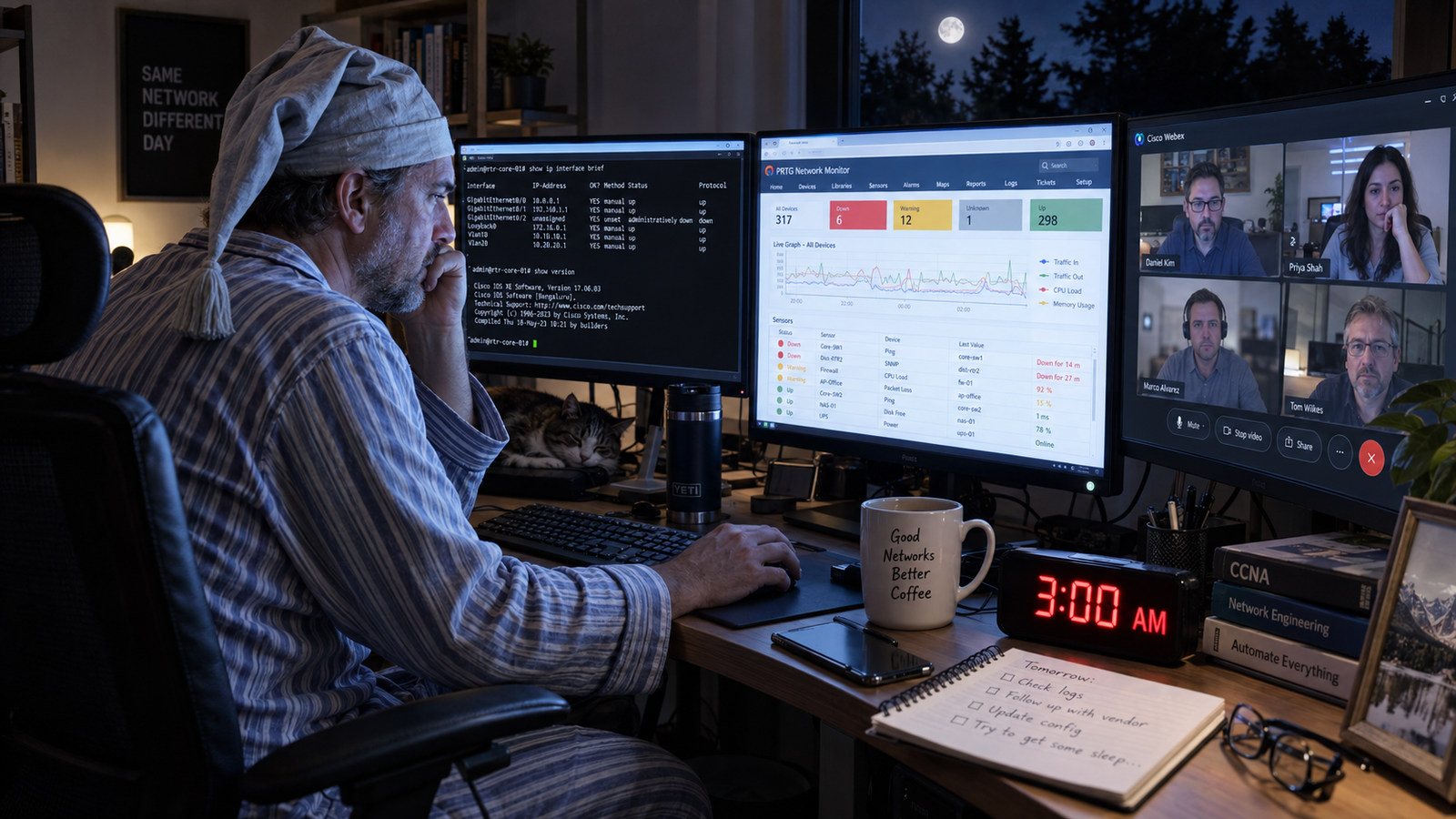
Escalation went to the level three network engineer. Not a rotation. A person. He was the path for anything the thinner tier could not clear, which was now considerably more than it had been.
The night shift supervisor position was eliminated. The night shift work was not. The supervisor who worked days took the call, and after a while managers on that team stopped going off the clock in any meaningful sense.
Not one of those was decided as a question of availability.
Every one of them was a decision about cost, headcount, or consolidation, and every one of them was survivable only because somebody’s phone was on. Availability was the input that made the math work, and it was free, so it never entered the math. Nobody approved it. Nobody costed it. Nobody was asked to give it up, because nobody named it as a thing being taken.
The boundary was not removed. It was spent. It bought something, and the purchase never showed up on the ledger, because there was no line for it.
A shift is not a person who is awake
The substitution looks clean on an org chart, and it is not.
A shift is an owner. It is someone whose job for those eight hours is that environment and nothing else, who came in on a handoff, who has been watching the behavior accumulate since midnight, and who has the authority to act without waking anyone. The context is not written down anywhere. It is built over the course of the shift by paying attention.
The call-out produces something different. It produces a responder with no context, no handoff, and no accumulated read on the night, who worked today and will work tomorrow, arriving cold into a problem that a present owner would have seen forming an hour earlier.
So the incident gets a worse response. And the capability needed at nine the next morning gets spent at three.
That is the part that never lands anywhere it can be counted. The savings post to the quarter they were taken in. The cost shows up as slower resolution, thinner mornings, and an engineer whose judgment is degrading in a way no report has a column for.
The vocabulary did the moving
Two words carried the transfer, and they were aimed at two different audiences.
Streamlining made it invisible to the people approving it. It described a reduction in structure without describing what the structure had been holding, and it sounded like competence.
Work ethic made it invisible to the people absorbing it.
That word is the one worth sitting with, because unlike the first it is not a euphemism. Work ethic is real. It predates every piece of technology in this essay. It is the reason the level three engineer answers at three in the morning, and it is a thing worth having. That is precisely what makes it usable. You cannot object to what is being asked of you without appearing to object to a virtue you hold.
And here is the flaw that was never visible until now: the ethic has no stopping rule in it. It never needed one. It contained diligence, care about the outcome, and unwillingness to leave a thing broken, and it contained no instruction whatsoever about when enough had been done, because the world supplied that instruction on its own.
Remove the world’s instruction and there is no quantity of availability that satisfies the virtue. There cannot be. The ethic was never the part that said stop.
There is no metric for donated hours
An organization running on unpaid availability and an organization that is genuinely resilient produce identical dashboards.
Both are green. Incidents get worked. Tickets close. Coverage looks continuous on the report, because it is continuous, and the report has no field for what continuity is made of. The engineer answers every time, so nothing registers as a failure, so nothing prompts a review.
The first signal is attrition, and attrition is a terrible signal because it fires after the fact. By the time the resignation arrives, the knowledge it represents has already left the building, and what replaced the NOC’s depth was that specific person’s memory.
The design also concentrates. Load runs toward whoever answers, and who answers is not a measure of character. People decline because they are caring for a parent, managing their own health, or holding a commitment that does not move. What the design locates is the people currently able to absorb it, and then it treats that capacity as a property of the system rather than a circumstance of their lives. Circumstances change. The model has no provision for it, because the capacity was never recorded as a dependency in the first place.
What we carried out of the building
It is Sunday. Nobody paged me. There is no rotation with my name on it and no escalation path that terminates at this picnic table. I have the cleanest off switch available to anyone in this essay, which is the off switch of a man nobody is escalating to.
In decades of corporate IT I never declined a call. Not once, at any hour, on any day, from any location. I answered texts within moments, sometimes only to say I was in a meeting and would follow up when it ended. Nothing was accomplished by those messages. Their entire content was that I was reachable.
I am not going to pretend that writing this violated my own Sunday. I wanted to write it. That is not the tell.
The tell is what happens now. Something arrives here at an hour that has no business being answered. Nobody is escalating to me. No reputation is at stake, no review, no room I am not in, no assessment accumulating anywhere.
I answer it.
The structure had to compel me. It does not have to anymore. Compulsion turned out to be the expensive way to do this, and it found a cheaper mechanism—already installed, already load-tested over a working lifetime, requiring no budget line and no approval.
Telling you to stop used to be the work of distance and copper and the hour the building locked.
It is our work now, and we have never once done it.
Discover more from At Ground Level
Subscribe to get the latest posts sent to your email.