Everything Can’t Be P1
Every outage is a P1.
Just ask the customer.
Not most outages. Every one. A service degrades, a report runs late, a printer in one office stops answering, and the ticket arrives flagged critical—and if you classify it lower, the customer escalates until it isn’t. For years I ran major-incident operations at a managed-services provider, and I wrote the severity definitions the contracts referenced. The customers had those definitions. They had signed them. They wanted everything to be a P1 anyway.
That is not ignorance. It is a wish, and a specific one: the wish for a priority system in which nothing is ranked below anything else. It cannot be granted, and not because of policy. Because of arithmetic.
Priority is relative or it is nothing
A severity label is not a measure of how much your problem matters to you. It is a position, relative to everything else in the queue, backed by a finite amount of capacity that someone sized and paid for in advance. A P1 buys a particular response—people pulled onto it now, a running clock, an escalation path—because the operation was staffed and priced around some expected volume of P1 work.
Reclassify ten ordinary incidents as ten P1s and you have not created ten times the engineers. You have taken the same capacity and instructed it to treat ten things as first. The word survives on the label and dies in the work, because you cannot make every position first. A priority scheme that ranks everything at the top is not a more responsive priority scheme. It is an unranked queue that costs more and tells you less.
There is a version of the wish that is honest, and it is worth naming. You can build an operation where nearly everything gets immediate attention—it is done for trading floors, for emergency dispatch, for systems where a minute of downtime carries real weight. But that is not a severity model. It is a staffing model, and it is priced like one: you pay for the idle capacity that sits ready so the response is always there. The demand to treat every incident as a P1 is really a demand for that operation, ordered without the invoice. Organizations try to buy one level of service and require another for free, and the severity label is where the gap between the two gets quietly hidden.
Two true things at once
Here is what makes the demand reasonable rather than foolish: from where the customer sits, the classification is correct. Their outage may genuinely be the most important thing happening to their business at that moment. They are not panicking. They are optimizing with the information in front of them, which is their own impact and nothing else.
The operation is optimizing with information the customer does not have—every other customer, every other incident, the technical capacity actually available, what is already mobilized. Both views are accurate. Only one of them can govern a queue.
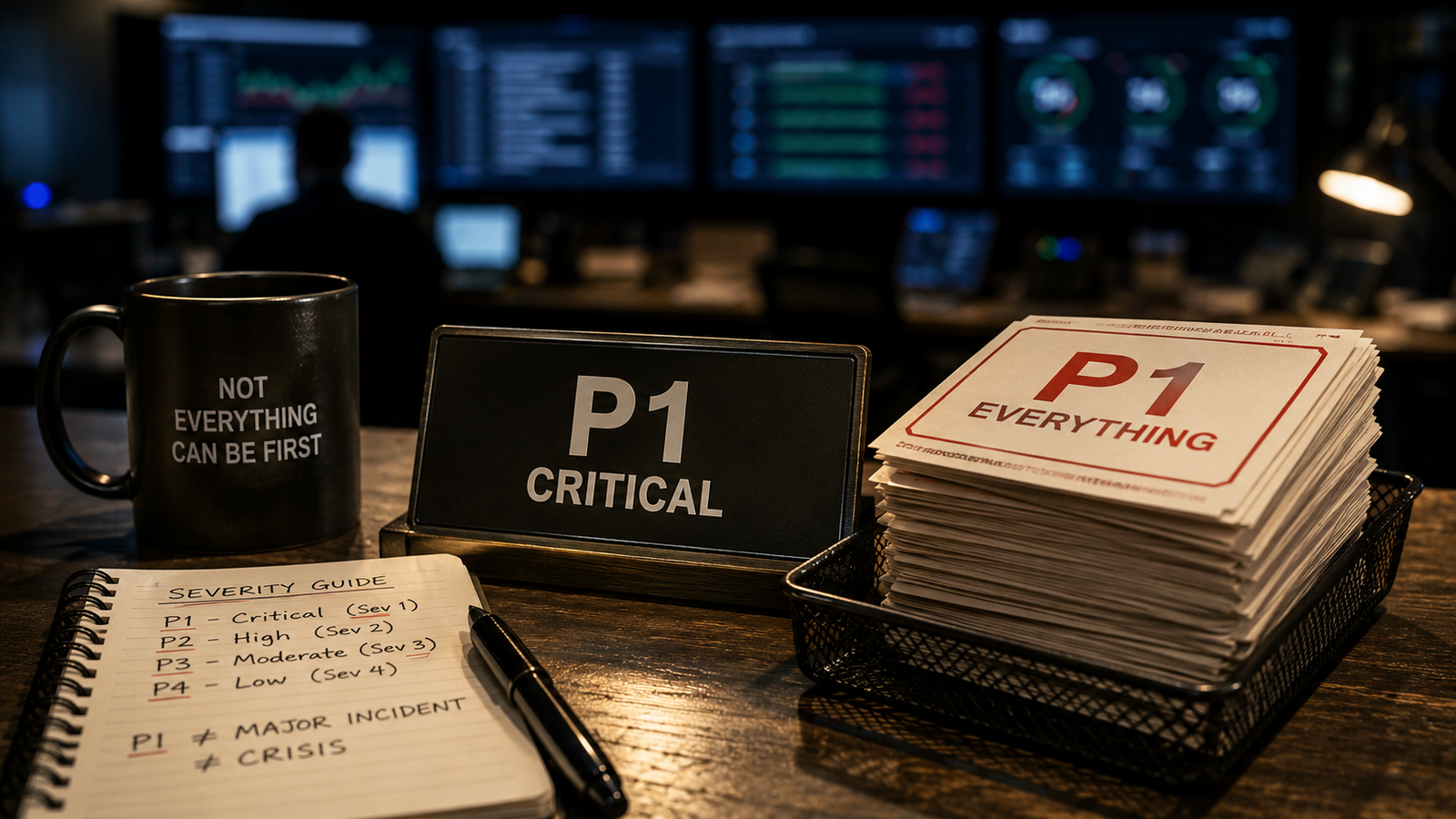
The trap is believing the only way to honor an urgent business reality is to inflate the technical severity. It isn’t, and a mature operation is built to prove it. The severity label was never the only instrument. P1 is a contractual severity. A major incident is a mobilization decision, and it can account for a strategic client, a reputational exposure, or a war room—without lying about how technically severe the incident actually is. A crisis is something else again, tied to continuity. Three instruments, because reality has more than one dimension.
And the three measure different things. A single user losing service can demand immediate executive attention when that user is the chief executive, without the incident being technically severe at all. A widespread failure inside a low-profile system can be genuinely severe while no one in the C-suite ever learns its name. Severity, visibility, and business importance overlap, but they are not the same quantity—and an operation that can only speak in severity has to distort one of them to say the others. When a minor incident carries major stakes, the honest move is not to relabel it. It is to put an executive on a bridge and leave the ticket where its severity actually sits.
The clock stops both ways
The place this stops being abstract is the clock.
Most of the time, when we stopped a P1 clock, it was because the work had left our hands—a vendor had to act on an outside system, or a failed component had to be replaced. Replacement parts were the worst of it. The part ships on its supplier’s schedule, and that can be days, and no amount of urgency on our end moves it. We could hound the vendor, and did. Hounding does not compress a hardware SLA. The part moved at the speed of a loading dock and a freight route; the contractual clock was a countdown that knew nothing about either. The clock stopped because there is no honest way to hold an operation to a timer for hours it has no power to move.
The customer wanted the clock to keep running anyway. Sometimes they escalated to their own C-suite, who would ask us to reinstate it, until we walked back through the contract and the clock came off again. And they would keep their own clock—running the entire time the part was in transit—and carry it into the compliance review at the end of the period, as a bargaining chip.
The objection was always some version of one sentence: the system is still down, so how is the clock not running? It is a fair question. They were not cheating. They were measuring something real. Their business clock had never stopped; their users still could not work while the part was in the air. But the business clock and the service clock measure different things, and the contract runs on the second one for a reason. Priority was never a promise that the customer would always come first. It was an agreement about the conditions under which they would—and the same document that pulls an entire operation onto a P1 also defines when that obligation is, and is not, running. You do not get to invoke the contract only in the direction that favors you.
Everything can’t be first
The customer’s sense of urgency is real. The operation’s need to rank it against everything else is also real. A priority system works only because those two things are not the same, and it holds only as long as the person asking for the label does not also control what the label means.
The moment everyone can declare themselves first, the label stops describing reality and starts describing volume. You still have a word sitting at the top of every ticket. It simply no longer tells you anything—it is on all of them now, and a rank that applies to everything has quietly become a rank that applies to nothing.
First is a position, not a feeling.
Discover more from At Ground Level
Subscribe to get the latest posts sent to your email.