Careful Was the Part I Could Do
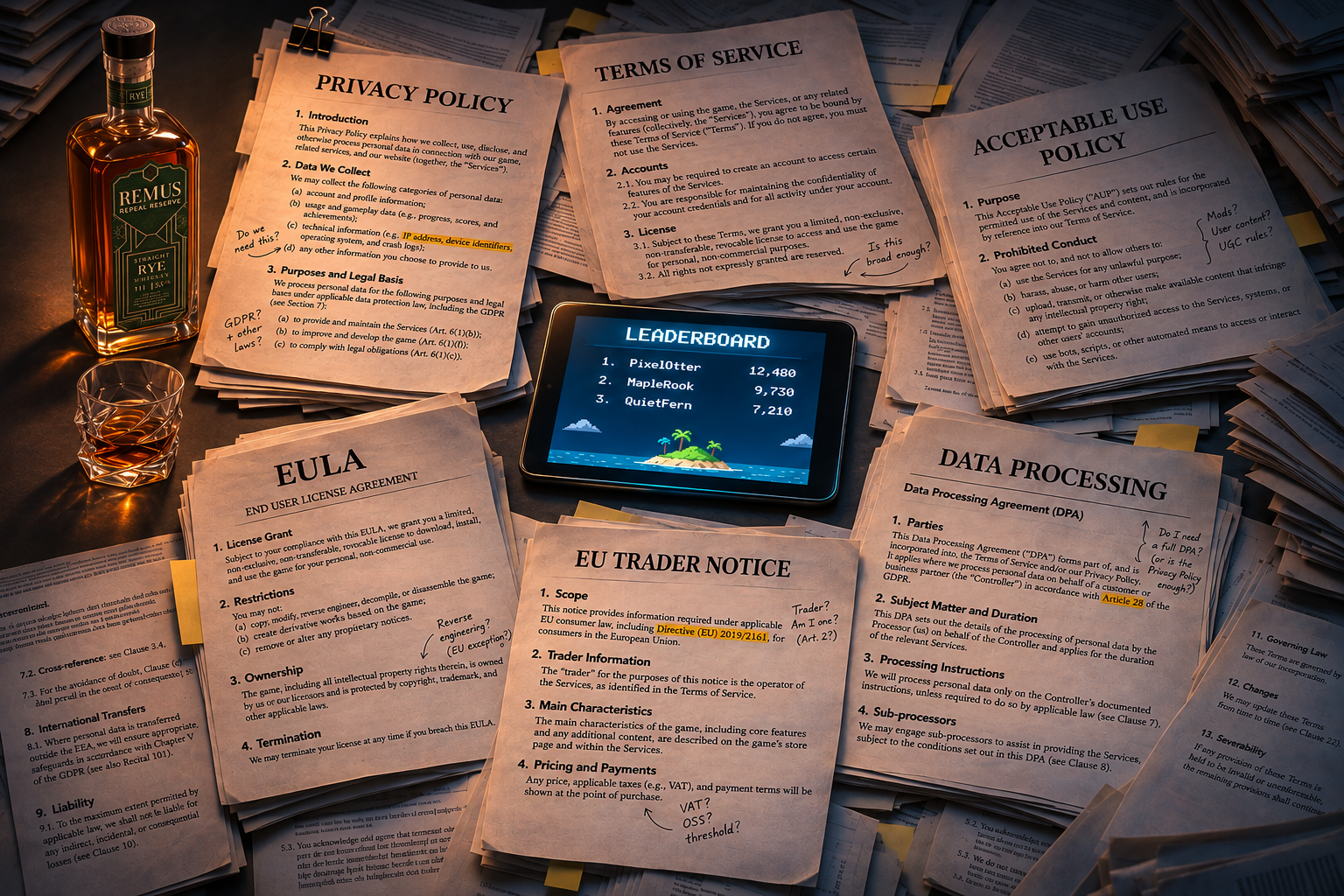
This week I rewrote the legal pages for Deep Dark Abyss Productions, top to bottom. The privacy policy. The terms of service. The trader notice for European customers. The rules for the online features in the games. The studio is one person and a dozen apps. The most sensitive thing most of them hold is a high score, and the only thing a player writes that another player can see is a name between three and twenty characters long.
The pages are live. They are careful, and every claim in them was checked against what the software actually does. I still cannot tell you whether they are right. Only a regulator or a court can settle that, and usually only after the fact.
The cost was already counted
The familiar complaint about regulation is that compliance costs money, and that small operators pay more of it relative to what they have. That is true. I made that argument here in September, in Who the Ban Can Bind, about a bill that would have charged admission to anyone building advanced AI: the overhead a large organization keeps in a department, a solo builder carries alone.
It holds just as well for laws already on the books. But cost is the part of compliance you can see. You can count the hours. What the hours leave behind is harder to count, and that is the part worth looking at.
Several laws, one leaderboard
An app sold in an online store is sold everywhere the store reaches. The same few pages answer to laws written in different places, for different purposes, about different things, and all of them land on the same small system.
Under the GDPR, pseudonymous data is still personal data. My games give each player a lasting code with no name or email behind it, and that code counts, because tied to a friends list and a history of play it can single someone out. That one I accept. The regulators have a real reason, and the reason holds even when a system was built to know as little as possible.
The Digital Services Act defines a hosting service as one that stores information provided by, and at the request of, its users. The definition was written with cloud hosts, marketplaces, and social networks in view. Read literally, it reaches a leaderboard that stores a twenty-character name a player chose. Whether it should is a matter of reading, and what follows from the answer is not small: a process for reports of illegal content, a statement of reasons for moderation decisions, a point of contact for authorities.
The age at which a child can consent to an online service using their data, where consent is the basis, is sixteen under the GDPR unless a member state lowers it, and none may go below thirteen. The number that applies to a player in Lisbon need not be the number that applies to a player in Vienna.
And the ground moves after the pages are written. My 2025 trader notice pointed European customers to the EU’s online dispute resolution platform, a link EU law required of traders established in the Union. Whether it applied to a studio in Ohio was itself a reading. Then the platform was discontinued on 20 July 2025, and the sentence became one sending readers to a service that no longer existed. Nothing told me.
None of this compels a single document. Regional versions are possible, and each is one more layer to write and keep current. The practical pressure on a one-person studio runs the other way: write once, to the broadest reading, and apply it to everyone. The most expansive rule ends up setting the floor for every user, including a player in Ohio it was never written to reach.
What counsel sells
A large company faces the same text. What it can buy is different.
It does not buy a guarantee. No lawyer can promise that a regulator will read a definition the way the lawyer did. What the company buys is a reading with a professional’s name on it, someone accountable for having given that advice, and someone already retained when the reading is challenged. It can outsource accountability for the reading. The interpretation becomes a deliverable, prepared by people whose job is to prepare it, in every jurisdiction where the question arises.
The solo operator supplies all of that himself. Two careful readings of the same definition can disagree about whether it reaches a twenty-character name. Somebody has to choose, and the published page records the choice. It does not record whether the choice was correct, how close the call was, or who would stand behind it if asked.
Two documents can be equally careful while their authors are not equally exposed. One author holds an opinion he paid for and can point to. The other holds his own judgment and defends it alone.
The credential nobody lists
Nothing in any of these laws says that publishing a puzzle game requires the ability to read statute, regulatory guidance, and court decisions. In practice it does.
I could do the work because I have spent decades reading statutes, case law, and regulatory guidance: pre-law first, then interpreting rules for a living in operations and in law enforcement, where how a rule had actually been applied mattered more than how it read. The regime never asks for that background. It quietly depends on people having it.
I used three AI models the way I would use a research staff: to pull provisions, test my readings against each other, and argue the other side. Where the published decisions ran out, they kept going in the same confident voice. I could see where that happened because I had read the law myself. Getting an answer and judging one are separate jobs, and the judging was mine.
Shipping on a best guess
Every operator makes the same decision under the same uncertainty. What differs is what each brings to it. Some bring a professional reading they paid for. Some happen to bring the skill. The rest bring a best guess, and either ship on it, carrying exposure they cannot size, or do not ship.
There is no count of that last group, and I will not invent one. The mechanism does not need one. Someone with a good idea and no legal training reads the same definitions I read, cannot tell whether a leaderboard makes them a hosting service, and has two choices: proceed without knowing, or stop. A product that was never published leaves no record of why.
Rules meant to protect the people who use software weigh least, relative to what is shipped and whom it serves, on the organizations best equipped to absorb them. They weigh most on small operators, including the ones that collect the least. The laws do scale. The DSA spares small companies much of what large platforms carry, and the GDPR’s duties track what is actually processed. But a lighter tier is still a tier someone has to read their way into. Deciding which obligations apply is the same interpretive work, and a small studio does it without anyone to sign beneath its reading.
Compliance is a position someone defends
The language of compliance talks as if it were a place. You are inside the safe zone or outside it. On the ground it does not work that way. Compliance is a position: a reading of the law, taken in writing, that someone may one day have to defend.
A large company takes that position with counsel already standing beside it. A small one takes it alone and learns whether it held only when someone challenges it.
The pages on my site are as careful as I could make them. Careful was the part I could do myself. The assurance that careful was enough is sold by the hour.