One Bad Day
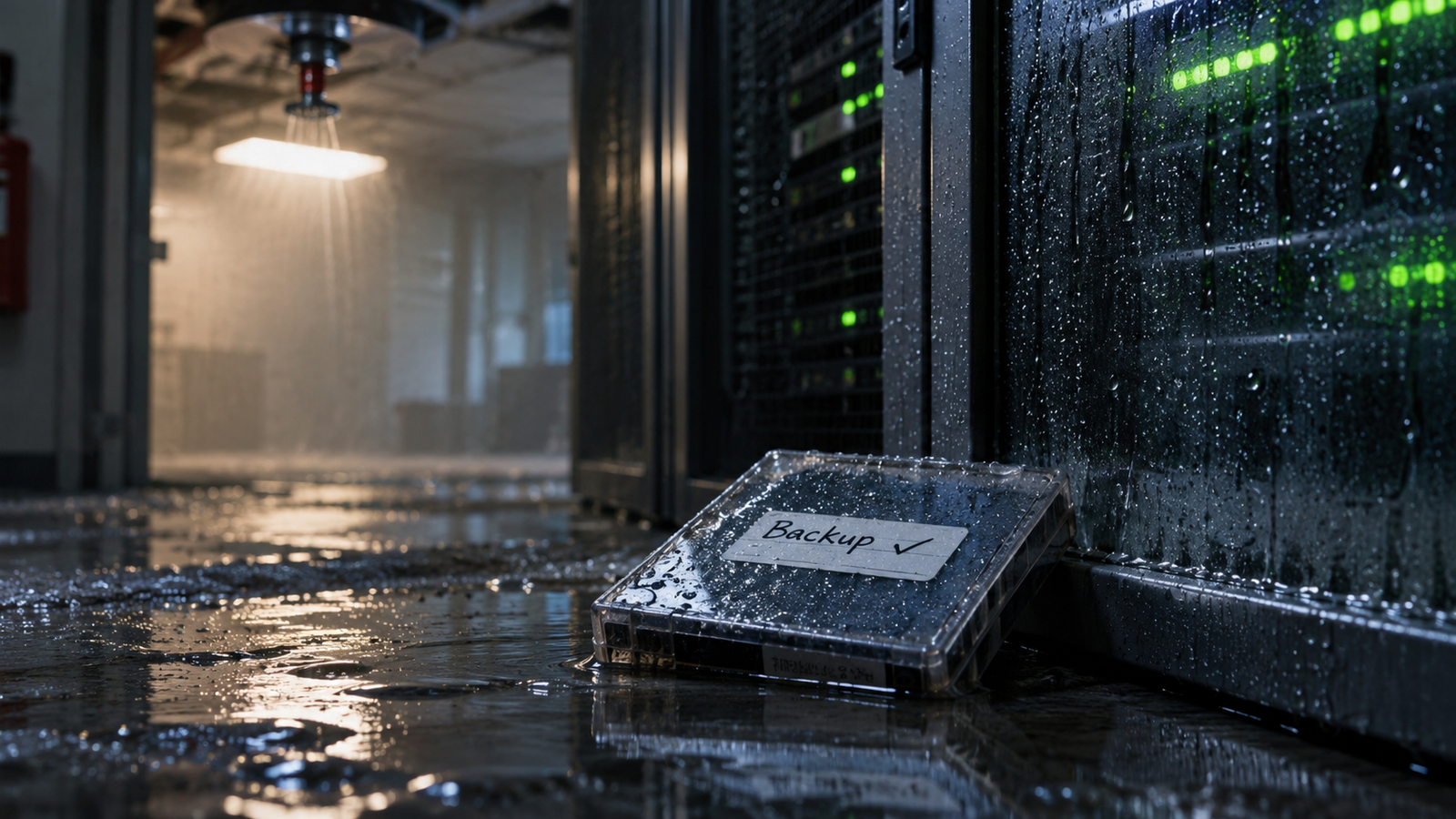
The fire itself was small. It never needed to be large. The suppression system in that room was water-based, and when it discharged it did exactly what it was designed to do: it kept the fire from reaching the rest of the building. Everything in the room took the water.
Within a day, sixty to seventy percent of the environment was back, restored from backup to roughly where it had stood the day before. On a day like that, it is a good number, and the people who produced it earned it.
Then we reached the rest.
Built for the day it was taken
The backups behind the remaining systems had reported success for months. Nobody had ever restored from them. When we did, the last two weeks turned out to be corrupted, and the reports had never said so. The jobs had run. What they wrote could not be read back.
The worst of them was encrypted in a way that bound it to the original hardware, a piece of equipment from a vendor nobody in the room had heard of. Without that device the backup could not be restored. It could not even be opened. The device had been in the room with the water.
None of it was new to me. Over the years I had gone to backups for a single lost system and found them corrupted, or complete except for exactly the data we needed. Once the backup was a tape, and the tape was not there. The log said it existed. The shelf said otherwise.
Every one of those backups was designed and judged on the day it was taken. On that day the data was in place, the tape was on its shelf, the device was running, and the job reported success. None of them had been checked against the other day, the one they existed for, when some of those things would be gone. Each carried an assumption about that day, and nobody had written the assumption down where anyone could see it was false.
The suppression system worked the same way. It was designed to protect the building, and it did. Nobody had accounted for what protecting the building would do to the equipment inside it.
What a test on the same hardware proves
The standard response is to test your backups, usually followed by the 3-2-1 rule: three copies, on two kinds of media, one of them off site. The advice is correct. It is also easy to satisfy in ways that would not have saved us.
A typical restore test brings a file, a folder, or a database back onto the system it came from. It runs in the building where the backup was made, on the hardware that made it, performed by the people who configured the job, with their documentation open in front of them. It passes. What it establishes is that the backup can be read under conditions identical to the ones that produced it.
A disaster is a change in exactly those conditions. The room is gone, or the controller is, or the device holding the key, or the person who knew the passphrase, or the binder with the tape locations. The hardware-bound backup would have passed a test on its own hardware every time anyone ran one. It would have failed only on the day the hardware was the thing that was lost, which was the only day that mattered.
A restore test means something in proportion to the loss it assumes. One that assumes nothing is lost tests the backup job. It does not test recovery.
Nobody owns the bad day
The obstacles to testing a full recovery are often technical. Leaving it untested is an organizational decision.
The team that runs the backups is measured on whether the jobs complete, and they complete. Application owners assume their data is protected because the report says it is. Leadership sees a success rate on a dashboard. Each of them is accountable for something real. None of them is accountable for the day of recovery: which building, which hardware, which people, how long the business can wait, and whether the data comes back at all. That question sits between all of them, which means it belongs to none of them.
It is the gap from Custody is Not Ownership: keeping something running and being answerable for what it does are different jobs. A backup team can run the jobs flawlessly for years. Answering for the restore takes someone whose job is to picture the bad day in detail and then rehearse it, and that job tends not to exist until the bad day has already happened.
When I wrote Three Systems Agreed, I said the backup console deserved its own piece. The console reported, accurately, what it had been built to report. It was built for a day that never came.
Six months, one platter at a time
The systems with corrupted backups took about a month to bring back, pieced together from whatever could still be read and rebuilt around what could not. That was the fast part.
The storage frame took nearly six months. It was an older frame, and the water had reached it. Its RAID arrays, several of them, each eight to ten drives in a single cabinet, could not simply be brought back online. Recovery started at the platters: data read off damaged drives, the arrays reconstructed from what came off them. What was recovered was then backed up, and that backup was restored onto a new storage frame of an entirely different design, because nothing like the old one was ever going to be the destination.
A recovery-time objective is written in hours, sometimes days. Nobody writes six months in that box. Six months is what recovery takes when the plan’s first step fails and everything after it is improvised by people inventing the procedure while the business waits.
Then the financial penalties came. Business was lost. The cost of an untested backup does not land on the backup. It lands on everything the backup existed to protect.
Green again
The response was thorough. Much hand-wringing. A move to a proper data center, with halon in place of water. New backup systems, with software checks built to make sure this could never happen again.
Each change answered something the fire had exposed. The water was gone. The checks were designed to catch the corruption that had just been found. Then the status indicators turned green, and in time the whole thing was forgotten.
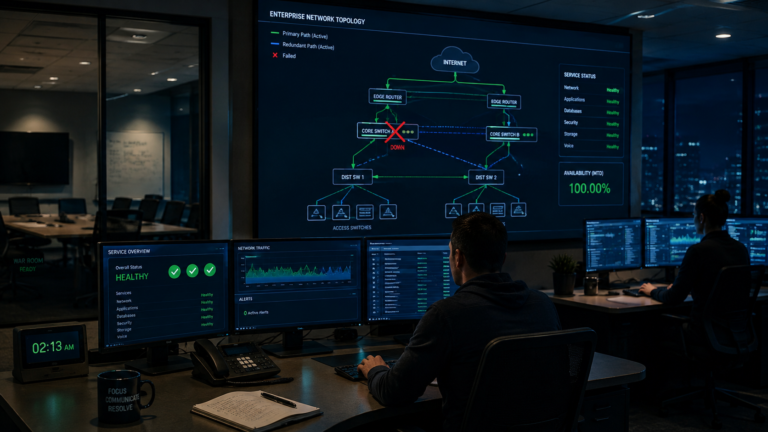
The new system had been designed from the day after the disaster, not the day of the next one. It produced the same green lights that had glowed, for months, over two weeks of unreadable data.
Green is what a backup looks like on every day except the one it is for.
Discover more from At Ground Level
Subscribe to get the latest posts sent to your email.